

In 2026, the majority of businesses in the UK and the US are spending about $1,500 to $10,000 a month in professional SEO services [1] that can actually give results. Therefore, with such hefty budgets, we can’t take risks with guesswork. Marketing is not a gamble anymore but a precisely strategized plan. And search engine marketing intelligence turns old-school advertising methods into data-driven science, by not just helping you find the target audience but also how and what they like.
Keep reading to learn how it works and also discover some of the marketing intelligence tools.
What is Search Engine Marketing Intelligence?
Search engine marketing intelligence is the process of collecting and analyzing search, advertising, competitor, keyword, and market data to understand how brands perform in search and make better marketing decisions.
It’s not just about bidding on keywords, but using paid search intelligence tools effectively by tracking metrics like CPC, CTR, Quality Score, impression share, CPA, and ROAS.
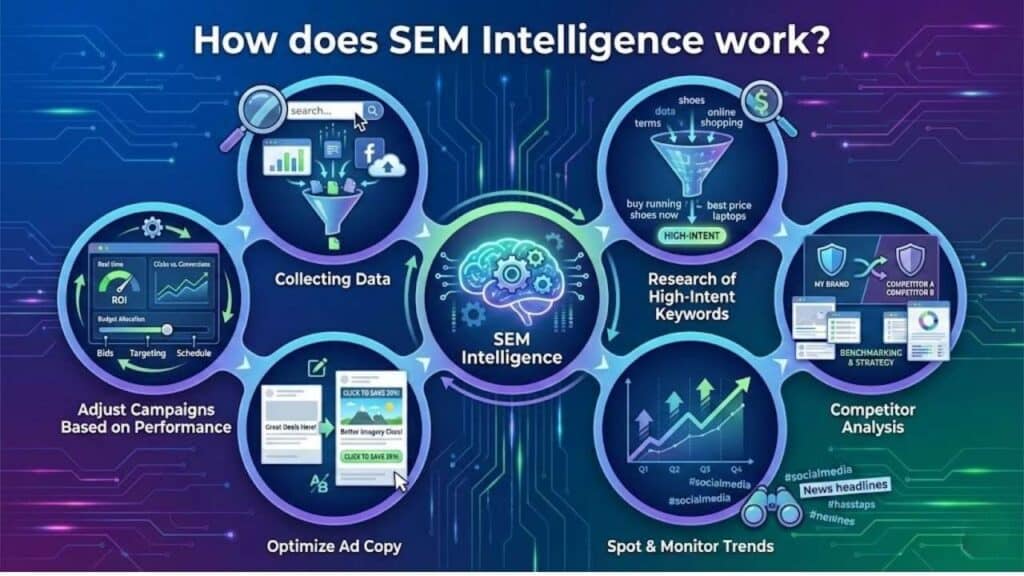
How does SEM Intelligence work?
There are a few steps in which SEM intelligence is used to bring the most out of it:
1. Collect search and advertising data
A large amount of paid search data is collected from various sources including paid ads, search queries, keywords, ad copies, extensions, bids, budgets, and more.
2. Research and Identify High-Intent Keywords
Various keyword research tools are used to find out the most used words in the search engines and high-intent keywords. Focus on long-tail keywords that match your users’ buying journey.
3. Analyze Competitor and Their Ads
Identify some top competitors and use tools to see what keywords they are bidding on, what types of ads they run, and how long those ads have been performing effectively.
4. Spot & Monitor Search Trends
It can help you set up trend alerts, predicting market shifts which help marketers prepare content and ads in advance. For example, the rise of eco-friendly and green products.
5. Optimize Ad Copy
Learn about headlines and descriptions used by your competitors. By using A/B testing, create high-performing and catchy ads.
6. Adjust Campaigns Based on Performance
Review your campaigns regularly and use the performance intelligence to change low success rate ads, reallocate budgets, and test new variations.
Advantages & Disadvantages of Search Engine Marketing Intelligence
| Advantages | Disadvantages |
|---|---|
| Better decision making as it is data-driven | The SEM reporting tools can be expensive |
| Resources can be used better | Involvement of third-party in data accuracy |
| Improves ROAS and CPA with the help of performance analysis | Requires technical expertise to interpret metrics |
| Helps in competitive analysis for better market visibility | Learning curve is high for beginners |
| Uncover new market and keyword opportunities | There can be delayed or limited real-time data |
| Reduced risk in campaign strategies | Large volume of data can be overwhelming |
6 Best Search Engine Marketing Intelligence Tools
1. SEMrush
SEMrush is built for marketers who want SEO, PPC, and competitor data in one place. Its core features include keyword research, competitor research, rank tracking, site auditing, and AI visibility monitoring.
With plans starting at $139/month.
2. Google Ads Keyword Planner
Google Ads Keyword Planner is a free Google tool for discovering keyword ideas and estimating search demand before launching campaigns. It provides keyword suggestions, search volume and forecasting data, competition insights, and bid estimates, making it a solid starting point for paid search research.
3. Ahrefs
Ahrefs is known for its huge backlink database, but it goes far beyond link analysis. Marketers can use it for keyword research, competitor analysis, rank tracking, site audits, content research, and emerging AI visibility insights.
The Starter plan is listed at $29/month, with Lite starting at $129/month.
4. SpyFu
SpyFu is a competitor intelligence platform built around SEO and PPC research. It lets marketers uncover competitors’ keywords, paid ads, rankings, backlinks, and historical search data.
Plans start at $39/month, while annual billing can lower the effective monthly price.
5. iSpionage
A focused alternative for PPC competitor research, helping you identify the keywords competitors target, the ads they run, and the landing pages behind those campaigns. iSpionage’ core features include competitor alerts, PPC monitoring, SEO rank tracking, landing-page research, and scheduled reporting.
Pricing starts at $59/month.
6. Adbeat
It designed for marketers who want to see how competitors are advertising beyond search. Features include display-ad research, publisher analysis, advertiser comparisons, placement tracking, ad alerts, and historical campaign data.
The Standard plan costs $249/month, while Advanced is $399/month.
Real-Life Use Case
Search engine marketing intelligence helped Digital First brands to drive success rates on Amazon by analyzing search data, optimizing product listings leveraging its unique A9 algorithm. The brands also saw boosted visibility through targeted keywords, PPC campaigns, and share-of-search tracking.
It made it easy to identify high-intent customer requests, refine product titles, descriptions, and images for better rankings.
When SEO and intelligent PPC are combined and paid sales fed on rankings, this holistic approach creates a cycle of increased traffic, conversions, and market dominance on Amazon.
SEM vs SEMI
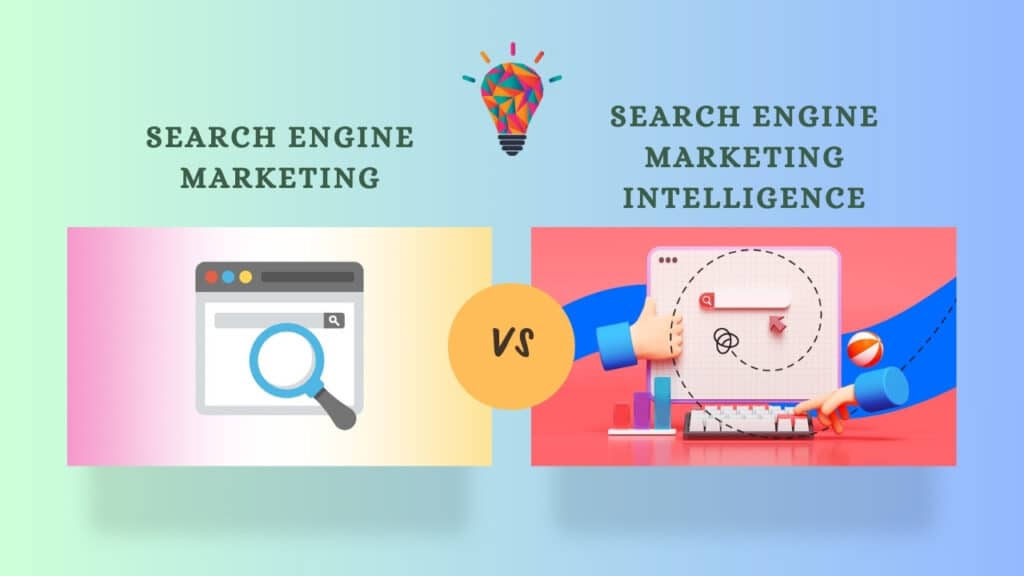
Search Engine Marketing (SEM) = executing paid search campaigns.
Search Engine Marketing Intelligence = analyzing search and advertising data to understand competitors, opportunities, trends, performance, and market behavior.
| Search Engine Marketing | Search Engine Marketing Intelligence |
|---|---|
| To run paid ads for instant visibility and clicks | Primary work is to analyze the paid search data to data-driven strategies |
| Key activities include keyword-bidding, ad copywriting, landing page optimization, campaign monitoring | Competitor analysis, trend prediction, share-of-search tracking, and performance dashboards are key activities by SEMI |
| Offers short term gains within hours or days of launch | It serves you with long term benefits through refinements that can take weeks or months |
| Measures in CTR, CPC, conversion rates, ROI from campaigns | Measurements are about search volume trends, keyword difficulty, competitive density, opportunity scores |
| Risk can be about high costs budget is not used wisely in bidding | There can be data fatigue due to overload of data and no actions taken, dependency on tool accuracy |
Final Word
Search engine marketing intelligence is an essential component of modern digital advertising. The marketing and advertising industry is one such sector that can never stop and is always moving upward and forward with every new innovation. And today it’s not about guesswork but decisive moves taken to increase the brand visibility, success rates, and ROIs. And SEMI helps you do it smoothly, by analyzing all your paid search data from various sources and turning it into actionable insights.
It enables you with a smart, planned, strongly competitive and sustainable growth in a data-driven search ecosystem.
Related: How to Get Into Digital Marketing: A Step-by-Step Career Guide
Related: Why Content Syndication Should Be in Your Marketing Strategy
-: Sources :-
[1] – SEO Pricing in 2026
Pingback: Google Search Console vs Google Analytics