


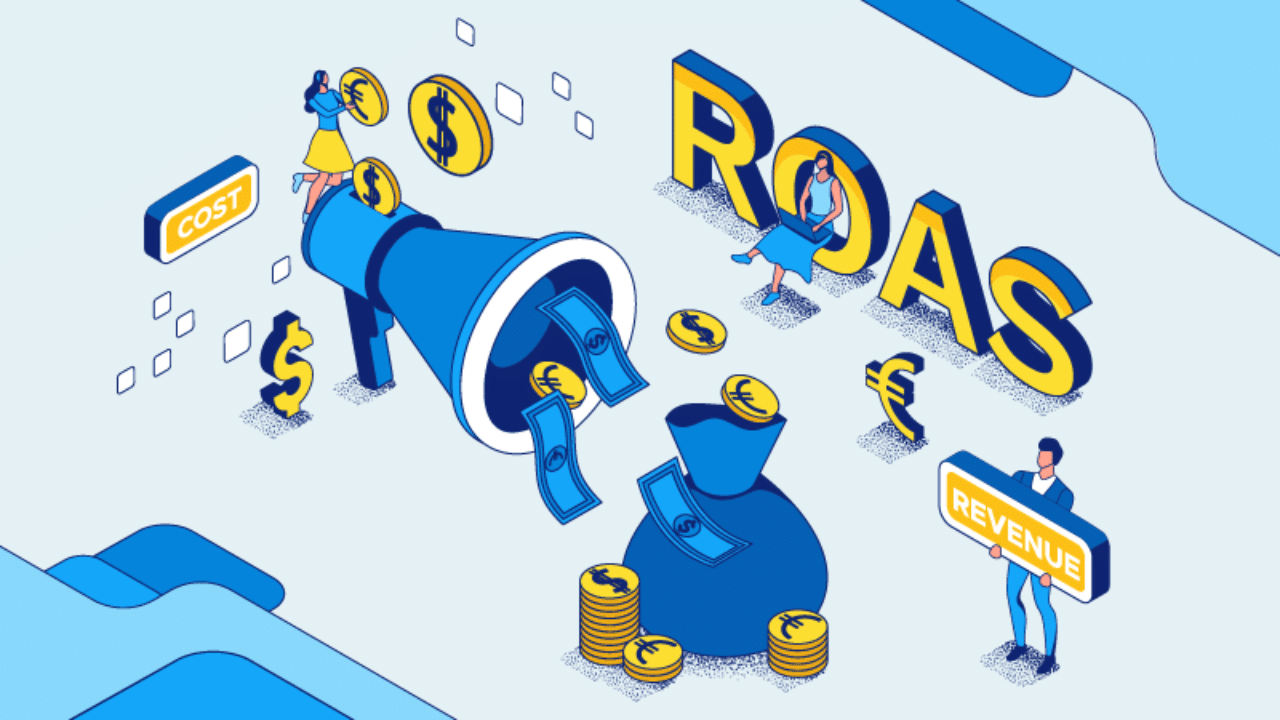
If you’ve ever asked yourself, “Am I spending too much on ads or not enough?” you’re not alone. Understanding your ROAS is like having a performance scorecard for every campaign. Once you know your industry benchmarks, you can finally tell whether your ad spend is paying off or just treading water.
What Is a Good ROAS
ROAS, or Return on Ad Spend, shows how much revenue you earn for every dollar spent on advertising. It’s calculated by dividing total revenue from ads by the amount spent on them. For example, if you spend $1,000 and generate $5,000 in sales, your ROAS is 5:1. A “good” ROAS depends on your industry, goals, and profit margins, but most businesses aim for at least 3:1 as a solid performance indicator.
ROAS Formula
ROAS = Revenue from Ads / Cost of Ads
Example: If you spent $1000 on Facebook or Google Ads and it generates you a revenue of $3000 from those ads. Then your ROAS is;
ROAS = 3000/1000 = 3
That means your ROAS is 3:1, or for every $1 spent on advertising, you earned $3 in revenue.
ROAS Calculator
To understand it more clearly, we asked several marketers and experts from different industries. We also compiled some of the best explanations, experiences, and insights to help you get the full picture. Have a look at them.
1. Link between ads and sales
The Marketing Mantra for every business in the universe is "Sales and Profit....Sales and Profit..."
And along these lines, I have developed some very effective, very essential, and very easy-to-use marketing math that can help all kinds of businesses make a lot more money a lot faster.
The math is math that will actually let you QUANTIFY the relationship between your advertising and sales, and businesses of all kinds can use the math to help them increase their sales, increase their profit and decrease their risk.
And...regarding ROAS...you can use the math to help you increase your sales and profit...AND...like the example above, with different rates of return...sometimes a lower ROAS can help you make a lot more money!
Robert Barrows, R.M. Barrows, Inc. Advertising & Public Relations
2. What Marketers Should Focus On

In the stages of my experience, a good ROAS depends on the sales cycle of the industry and the average customer lifetime value (LTV).
For high-value scientific instruments, we usually talk about a ROAS benchmark of 3:1 to 5:1, depending on the campaign's objective like awareness or lead qualification.
The most common error that I observe is that they treat ROAS as an isolated number rather than relating it to gross margins and retention potential, as well as the quality of conversion.
At Berthold, for example, we deploy attribution data through means such as Google Analytics and dashboards integrated with our CRM to identify which campaigns produce the greatest number of qualified leads, rather than just numbers of impressions.
The finer points of content-precision focalization have proved the best measures for improving ROAS, maximizing their educational value as opposed to simply gaining eyeballs.
What follows is my actionable takeaway: focusing less on the ratio itself and more on what drives profitable engagement behind that number.
Francesc Felipe Legaz, Digital Marketing Head at Berthold Technologies
3. Why a Low ROAS Doesn’t Always Mean Poor Performance
A "good ROAS" is only part of a greater equation, which is your LTV:CAC ratio. For example, your immediate ROAS could be 1x, which doesn't sound impressive (and isn't ideal), but this may be enough if you're selling a rolling monthly contract with very low churn, resulting in a great LTV:CAC ratio. Some businesses find success with an immediate ROAS lower than 1x, because their LTV is high.
Interpret ROAS benchmarks based on immediate ROAS and LTV:CAC. If your immediate ROAS covers your marketing cost*, then you should be more focused on increasing LTV. *Note that "marketing cost" includes the fee you pay your agency, the software you pay for follow-ups, etc.
An example from my own experience - a building company installing media walls in the UK. This is their ad spend, revenue generated and ROAS.
- Aug £11,050 / £400 = 27.6x
- Sep £16,910 / £400 = 42.2x
- Oct £13,690 / £400 = 34x
- Nov £13,600 / £400 = 34x
- Dec £12,500 / £400 = 31x
- Jan £9,700 / £400 = 24x
- Feb £10,120 / £400 = 25x
Their average ROAS over this period is 31x, which is great, but that doesn't account for the fees they paid to us to run those ads, which is why CAC matters. On top of that, they were not following up or upselling their customers, so their LTV remained flat as all customers only ever made a single transaction, which is why LTV matters.
To increase ROAS there are two methods I'd suggest to anyone:
Increase your LTV. Whether that means upselling customers onto a higher ticket product or service, designing a recurring subscription, or following up with customers to sell a different product or service. This makes your overall "ROAS" much higher, with the same marketing spend.
Use Meta Ads retargeting and automated follow-ups to stay present with prospects that have already shown buyer intent. These simple implementations will make much better use of your marketing spend than advertising to cold audiences.
Common mistakes that people make when it comes to ROAS:
Treating ROAS as profit, without considering their overall marketing spend (agency's fee, follow-up costs, etc.) or margin.
Counting leads, not closed revenue; an ad campaign might generate hundreds of leads, but if their close rate is extremely low, then a higher-intent, lower-volume method might yield better results (and save time contacting low intent prospects).
One actionable takeaway for any industry would be to calculate your LTV:CAC ratio, and your break-even ROAS. Consider how you can increase LTV, which will enable you to have a lower ROAS whilst remaining profitable.
Charlie Shaw, Director of Slingshot Marketing
4. How Top Advertisers Continuously Improve Their ROAS

There is no universal ROAS but the gross margin, customer lifetime value and channel costs, and thus most small businesses strive to achieve a 3 to 5 times ROAS as an approximation, and in my experience, that is more of a filter than a destination. Divide the total cost of goods and operating marketing overhead by average order value and calculate your break-even ROAS, and all ROAS targets are conditional upon an LTV and payback window that is mentioned clearly.
There are three things that advertisers do well who continuously enhance ROAS. They quantify landed economics rather than clicks thus they optimize ad spend to first purchase and at least one perceived repeat purchase; they segment by creative, audience and funnel stage hence optimization is surgical and they test with channel mixes, tight attribution windows and conversion lift tests.
Some of the pitfalls that I encounter include maximizing on last-click, pursuing a single top-line ROAS without the profitability post-fulfillment, and looking at platform averages as truth instead of local data. The onsite conversion is being enhanced to address the practical lever by 10 to 30 percent, average order value being enhanced by simple bundles, and customer value extended by follow-up offers, since each percent improvement doubles the result on the same ad dollar.
Jason Rowe, Director & Founder at Hello Electrical
5. The Hidden Limits of ROAS in Performance Marketing
Over the last 10+ years, I’ve worked with big brands like Microsoft, the NCAA and AG1.
As a direct response copywriter and performance marketer, ROAS is the only thing that pays my bills haha!
With that said, ROAS is inherently limited because of the many variables that go into paid ads and performance marketing.
So rather than aiming for an arbitrary figure, I’d tell a client to use their existing ROAS as their benchmark, then deep dive all aspects of their Acquisition and Retention Marketing so they can identify specific areas to improve:
As an example, paid campaigns (acquisition)
You have an ad copy, whose job is only to sell clicks —measuring performance comes down to CTR (Click-Through Rate) and CPC (Cost Per Click). This is how you measure the relevance of your message, and how it’s breaking through the noise.
The goal is here to split-test ads, first, based on their overall idea or concept. Once you’ve found your answer, you can split test smaller variances, like headlines, images and calls to action.
Then you have your landing page — measuring performance comes down to conversion rates.
Imagine your paid ad as a movie trailer, and the landing page as the movie. One teases the other, and in doing so, creates a certain expectation that the landing page will have to fulfill — otherwise, potential customers will bounce off of your website.
The point is, each step needs to be measured independently so you can clearly identify where to spend your time and budget.
Mike Lewis, Owner of Maverick Adverts
Ending Words
Every marketer has a different story when it comes to ROAS. Some see early wins, others learn through trial and error. What matters most is that you understand your numbers and use them to grow smarter, not just bigger. That’s what separates good marketers from great ones.
Related: 13 Things to Know Before Starting a Newsletter That Builds Loyal Readers
Related: How AI and Strategy Are Affecting SEO Pricing in 2026